 Log in

After migrating from misogynist forums to social media feeds, terms like “looksmaxxing” and “mogged” are now impossible to avoid.

It must be highly dependent on where you hang out. I have seen each of those terms exactly once before this article.
Austin, TX


October saw Bitcoin reach $123,742. But less than four months later, "The world's largest cryptocurrency slipped below $76,000..." Bloomberg reports, "dropping about 40% from its 2025 peak..."
"What began as a sharp crash in October has morphed into something more corrosive: a selloff shaped not by panic, but by absence of buyers, momentum and belief."
Unlike the October drawdown, there's been no obvious spark, cascading liquidations or systemic shock — just fading demand, thinning liquidity, and a token that's untethered to broader markets. Bitcoin has failed to respond to geopolitical stress, dollar weakness, or risk rallies. Even during gold and silver's violent swings in recent weeks, crypto saw no rotation. Bitcoin fell nearly 11% in January, marking its fourth straight monthly decline — the longest losing streak since 2018, during the crash that followed the 2017 boom in initial coin offerings...
Even more striking than the drop itself is the relative lack of optimism around it on social media. In a space known for relentless bravado and "number go up" memes, Bitcoin's slide has been met with little cheerleading or dip-buying fanfare... [Despite legislative wins and some institutional investments] Many investors say that optimism was front-run. Prices rallied early — and then stalled. Meanwhile, spot ETFs continue to bleed, a sign of weakening conviction among mainstream buyers — many of whom are now underwater after buying at higher prices.
On Thursday, Bitcoin closed at 88,228. By Sunday it had plunged another 13%, to 76,790...


Read more of this story at Slashdot.
"Ponzi scheme begins to falter when all the gullible have already bought in"
Austin, TX

Data: United Health Foundation / U.S. Department of Health and Human Services; Chart: Alex Fitzpatrick/Axios
About one in five Americans report doing no physical activity or exercise outside their job, per a new report.
Why it matters: Even just moderate exercise can have tremendous benefits for your physical and mental well-being, research has found.
Driving the news: The findings, from 2024 U.S. Department of Health and Human Services data, are highlighted in the United Health Foundation's new "America Health Rankings" report.
Zoom in: Mississippi (30.6%), West Virginia (28.7%) and Arkansas (28.5%) have the highest shares of adults reporting no physical activity other than work.
- Washington, D.C. (13.9%), Colorado (15.6%) and Vermont (16%) have the smallest shares.
- There's no data for Tennessee.
Between the lines: While the states with the least active adults tend to rank poorly in other health metrics, other factors could be at play here.
- People who work physically demanding jobs, for example, may be less likely to exercise for fun than desk jockeys.
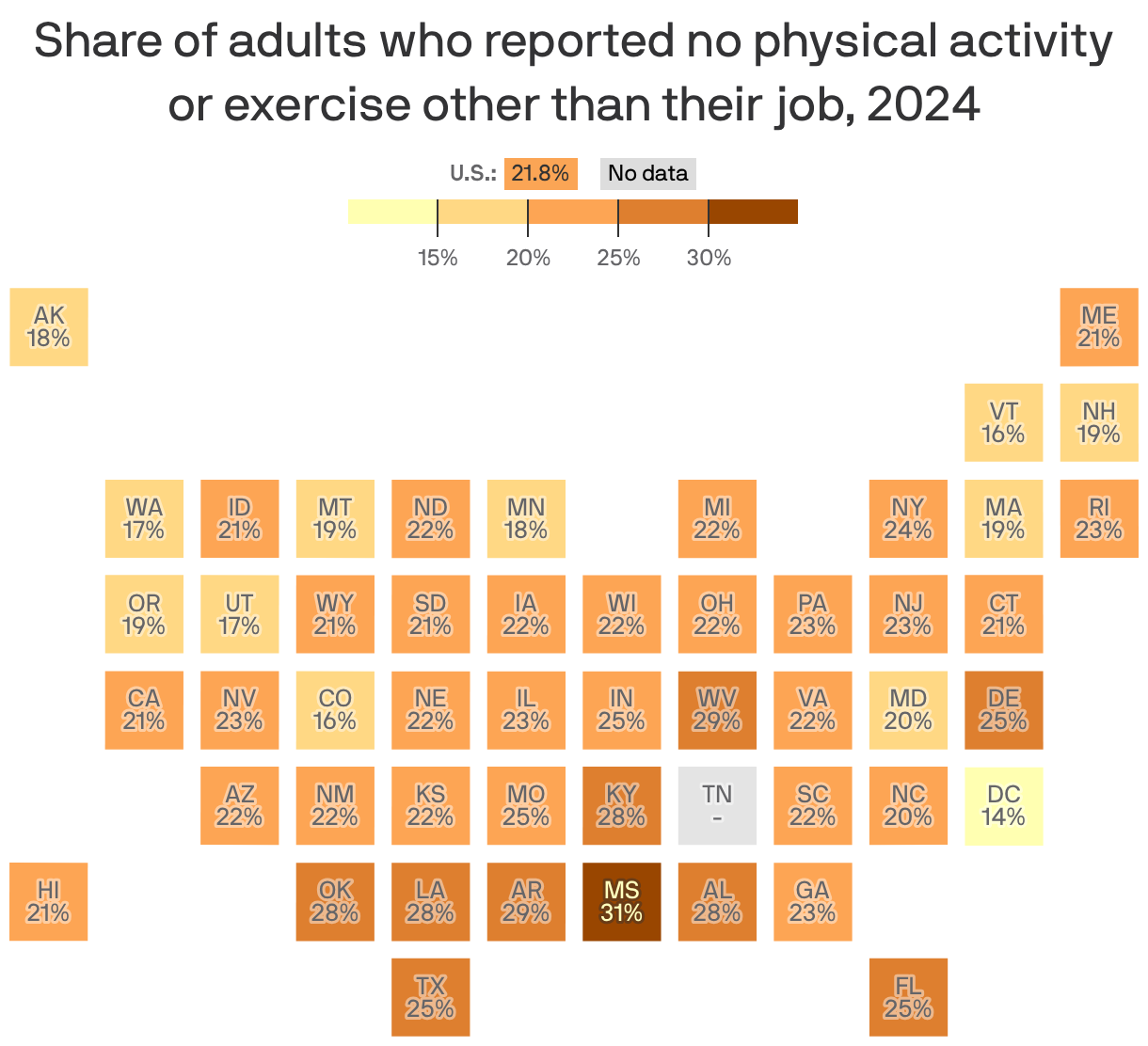
Tennessee was too lazy to even respond.
Austin, TX



<3
Austin, TX
7 public comments

"Buy Verified Google Ads AccountsFind us at Email:SmmSeousaofficial@gmail.com WhatsApp:+60179689850 Telegram: @Smmseousa
Buy Link:https:https://smmseousa.com/product/buy-verified-google-ads-accounts/
##buyverifiedGoogleAdsaccounts #GoogleAdsaccounts #verifiedGoogleAdsaccounts #GoogleAds #MachineLearning #DataScience #5G #100DaysOfCode #Python #Cybersecurity #BigData #AI #IoT #DeepLearning #ArtificialIntelligence #NLP #robots #Industry40 #tech #javascript30"
Buy Link:https:https://smmseousa.com/product/buy-verified-google-ads-accounts/
##buyverifiedGoogleAdsaccounts #GoogleAdsaccounts #verifiedGoogleAdsaccounts #GoogleAds #MachineLearning #DataScience #5G #100DaysOfCode #Python #Cybersecurity #BigData #AI #IoT #DeepLearning #ArtificialIntelligence #NLP #robots #Industry40 #tech #javascript30"
Why's my face leaking?
Shelbyville, Kentucky
<3
tbd


 reply
reply


Tesla shares fell early Thursday after Commerce Secretary Howard Lutnick used a TV appearance to urge Americans to buy stock in Elon Musk's car company.
Why it matters: Cabinet secretaries don't typically recommend individual stocks, much less those linked to the president's closest adviser.
- His recommendation was potentially overshadowed, though, by one of Tesla's most fervent defenders on Wall Street calling the company's situation a "crisis."
What they're saying: "I think, if you want to learn something on this show tonight, buy Tesla," Lutnick said on Fox News Wednesday evening. "It's unbelievable that this guy's stock is this cheap. It'll never be this cheap again."
- "I mean, who wouldn't invest in Elon Musk? You gotta be kidding me."
By the numbers: Tesla shares were down about 1.7% in premarket trading Thursday to $231.75.
- The stock is down 5% in the last five days, 35% in the last month and 42% so far this year.
- "We struggle to think of anything analogous in the history of the automotive industry, in which a brand has lost so much value so quickly," JPMorgan analyst Ryan Brinkman said in a research note last week.
Between the lines: Lutnick's comments are part of what has effectively become a Trump administration campaign to defend Tesla.
- Last week President Trump held a public showcase of Tesla's cars at the White House.
- Amid a wave of "Tesla Takedown" rallies at dealerships nationwide, top administration officials have pledged to investigate protesters for domestic terrorism.
Of note: Just hours before Lutnick's comments, Cantor Fitzgerald — the investment bank where he was previously CEO, which is now managed by his sons — upgraded Tesla's stock.
The intrigue: Lutnick's recommendation came as one of Wall Street's most bullish Tesla analysts sounded the alarm on the company's future.
- "Lets call it like it is: Tesla is going through a crisis and there is one person who can fix it....Musk," Wedbush Securities' Dan Ives wrote in a research note Wednesday night.
- "As someone who is a core bull and believer in the Telsa long term growth story.....I loudly urge Musk and the Board to step up, stop being silent, and help resolve this crisis forming at Tesla," Ives said.

Th only way Tesla will recover is if Musk steps down and sells all his stock, which would totally tank the stock price. Tesla is falling farther and farther behind the Chinese EV manufacturers and I think the future is dim for Tesla
Austin, TX
Megan Hellerer, a career coach and founder of Coaching for Underfulfilled Overachievers, offers an alternative to the relentless "hustle culture" and "destinational living" mindsets, which often emphasize long-term goals at the expense of present happiness. "There's another way and I call it directional living," writes Hellerer. "Here's the catch: I can't find fulfilment for you. The good news is that it's all up to you..." An anonymous Slashdot reader shares an excerpt from the report published by The Guardian: Directional living is like the scientific method but for life. You begin with a hypothesis -- your best guess as to the direction of a loose "something bigger". You conduct tests and collect data through your experiences, refining your life hypothesis as you go.
If you have a hypothesis that involves living on the beach, you may test that by renting a house on the coast for one month and collecting data on how right, or not, that is for you. The goal is not to permanently relocate but to find out whether you want to continue exploring that path. Success is in finding what's true, not in proving your original theory correct.
I've found this idea speaks uniquely to UFOAs at this moment in time. [UFOA is a term Hellerer came up with that stands for "underfulfilled overachiever." This describes a constant striver who is living a great-on-paper life, yet feels disconnected from their work, life and self.] The closest thing I have to a personal motto is a quotation that's widely attributed to Carl Jung but that, as it turns out, he never actually said at all. "The privilege of a lifetime is to become who you truly are." My greatest hope for you is that you get to live this privilege fully.
Read more of this story at Slashdot.
"Directional living" sounds very much like Scott Adams' (yes, I know he's gone full MAGA, but that doesn't mean he's never had good ideas) advice about building systems rather than setting goals. e.g. If I set a goal to have $1000 in savings and then find $1000 on the street and put it in the bank, goal achieved. But did I learn anything? Instead if I set up a system to save $100 every week then I (hopefully) learned the value of saving.
Austin, TX
Next Page of Stories